
AMarkets
A Complete Review of AMarkets: Offshore Registration, Real Risks, Bonus Pitfalls, and Client Reviews
AMarkets review. In the world of online trading, choosing a broker is not just about finding low spreads or a convenient platform. It’s about choosing a counterparty to whom you entrust your money. AMarkets has been operating in the market since 2007 and positions itself as a broker with a client base of millions. Their website, amarkets.com, is filled with accolades: “instant withdrawals,” “execution from 0.03 sec,” and membership in the Financial Commission.
However, behind the attractive banners lies the harsh reality of regulatory arbitrage. The main goal of this article is to provide the most complete, honest, and truthful AMarkets review possible – one that doesn’t just repeat information from the official website but analyzes it through the lens of client fund security. We will dissect in detail what it means to operate “offshore,” what licenses the company actually has and doesn’t have, how their affiliate programs and bonuses work, and what traders are genuinely writing in their reviews.
AMarkets review. Registration and Regulation. The Truth About “Offshores”
The Geography of Legal Entities: Comoros, Cook Islands, St. Vincent
When we start analyzing the safety of any broker, the first question is: “Who specifically is my counterparty, and who oversees them?” AMarkets does not have a single legal entity. Like many other brokers serving clients from the CIS, Asia, and Europe without “heavy” licenses, the company uses a structure involving several offshore jurisdictions.
According to official data, AMarkets’ structure looks like this:
- AMARKETS LTD – Registered in the Comoros Islands (Mwali International Services Authority – MISA). License: T2023284. This is the newest and currently popular offshore jurisdiction. MISA issues licenses for international brokerage and clearing activities, but the level of supervision and investor protection is minimal.
- AMARKETS LLC – Registered in the Cook Islands (Financial Supervisory Commission – FSC). Registration number: LLC14486/2023.
- AMARKETS LTD – Registered in Saint Vincent and the Grenadines (Financial Services Authority – FSA). Number: 22567 BC 2015.
Many review sites state that AMarkets is regulated by the FSA, FSC, and MISA. This is legally correct but highly misleading in terms of substance. Why? Because having a registration is not the same as having prudential supervision.
AMarkets review. What Does an “FSA SVG License” Really Mean?
Saint Vincent and the Grenadines is perhaps the most striking example of a “grey” zone in forex regulation. The country’s regulator (FSA) does not issue licenses for conducting forex brokerage business as such. Companies are registered there as International Business Companies (IBCs). This is business registration, not licensing for financial activities.
As noted in authoritative sources on broker safety, the FSA of St. Vincent itself has publicly stated that it does not regulate, supervise, or license international companies engaged in currency or CFD trading. The FSA acts merely as a company registrar.
What does this mean for the client?
When a broker writes that it is regulated by the FSA (SVG), it’s a marketing ploy. Essentially, it means the company simply bought a “shelf” in an offshore register. No one checks capital adequacy, no one demands quarterly reporting under rigorous IFRS standards, and no one monitors whether client funds are segregated from the firm’s working capital. This is a fundamental drawback that outweighs many potential advantages.
AMarkets review. Comoros Islands (MISA) and Cook Islands (FSC): The “New” Offshores
In recent years, many brokers, including AMarkets, have added the Comoros Islands or Cook Islands to their registration. MISA does issue licenses, but they fall into the “offshore” (low-tier) category. Capital requirements there are minuscule compared to the London City or Australia, and oversight of compliance with these requirements is often formal.
Low to mid-tier regulators, like MISA and the Cook Islands FSC, simply do not provide the same level of protection as top-tier regulators (the FCA in the UK, BaFin in Germany, CySEC in Cyprus). They often lack strict rules and supervisory resources.
What is the Financial Commission, and Does It Replace a Regulator?
The AMarkets website prominently states: “The Financial Commission. The interests of AMarkets clients are protected by the Financial Commission’s Compensation Fund for up to €20,000 per claim.”
It’s crucial to understand the difference:
- State Regulator (FCA, CySEC): This is a supervisory body vested with state authority. It can impose fines, revoke licenses, and initiate criminal prosecution. Compensation schemes (like the FSCS in the UK) are government-backed.
- The Financial Commission (FinaCom): This is a non-governmental, private, self-regulatory organization (SRO) – essentially funded by the brokers themselves.
Membership in FinaCom is a marketing tactic designed to create a sense of security for the client. In reality, there are numerous reports questioning the effectiveness of such private schemes, and some sources suggest that payouts from this organization are not guaranteed.
AMarkets review. Red Flags: Warnings from International Regulators
The most alarming signal in any AMarkets review is the presence of official warnings from national regulators in other countries. According to analytical data, AMarkets has been publicly listed in warnings by authorities such as:
- The Securities Commission Malaysia (SC Malaysia)
- The National Securities and Stock Market Commission of Ukraine (NSSMC)
- The Italian Companies and Exchange Commission (CONSOB)
What do these warnings mean? The regulators of these countries have determined that AMarkets offers its services in their territory without the required local license. For a potential client, this means the broker is willing to operate in a “grey” area, ignoring local investor protection laws. If a broker disregards the law in one country, is there any guarantee they will be honest with you in another?
Safety Conclusion: Comparison with “White” Brokers
AMarkets is a classic offshore broker. It does not possess top-tier licenses (FCA, ASIC, CySEC) that entail strict supervision, segregation of funds in top-tier bank accounts, and government compensation schemes.
AMarkets’ initiatives (FinaCom membership, VMT audit) are attempts to boost client confidence, but they do not solve the core problem: your money is held in a low-protection jurisdiction where the company can change the rules of the game with little to no oversight. The high leverage (1:3000) they offer is banned in Europe precisely to protect clients from instant ruin. Here, it’s used as a marketing hook.
AMarkets review. Trading Conditions and Products
Despite the regulatory risks, AMarkets offers a wide range of products that attract clients.
Trading Instruments
The broker provides access to over 500 instruments, as stated on their website and app. Categories include:
- FX (44 pairs): From majors (EURUSD, GBPUSD) to exotics (USDTRY, USDZAR).
- Stocks (400+): CFDs on giants like Tesla (TSLA.US), Apple (AAPL.US), Google.
- Indices (11): S&P500, Nasdaq, FTSE100, etc.
- Commodities & Metals: Brent and WTI Crude Oil, Gold (XAUUSD), Silver.
- Cryptocurrencies: Bitcoin, Ethereum, and altcoins against the US dollar.
- ETFs (19).
Account Types: Standard, ECN, Zero
AMarkets offers three main account types.
- Standard Account:
- Minimum Deposit: $100
- Spread: from 1.3 pips (floating)
- ECN Account:
- Minimum Deposit: $200
- Spread: from 0.2 pips
- Commission: $2.5 per lot per side ($5 round turn)
- Zero Account:
- Minimum Deposit: $200
- Spread: from 0 pips (90% of the time on major pairs)
- Commission: $5.5 per lot per side
Spreads, Commissions, and Leverage
- Spreads: During news events or high volatility, spreads can widen significantly.
- Leverage: Maximum leverage is 1:3000. This is a guaranteed way for traders to lose their money. With 1:3000 leverage, a market move of just 0.03% against your position can wipe out your entire deposit if you use maximum leverage. Such high leverage is a marker of a “gambling zone,” not an investment environment.
AMarkets review. Trading Platforms and Technology
The technical side is arguably AMarkets’ strongest aspect and generally receives no complaints.
MetaTrader 4 and MetaTrader 5
The company relies on the industry standards – MT4 and MT5. These are stable platforms familiar to millions. Desktop versions (Windows, Mac), web terminals, and mobile apps are available. Support for MQL4/MQL5 allows the use of Expert Advisors (EAs), which is important for automated trading.
AMarkets review. Analytics and Education
To attract and retain clients, AMarkets has developed a strong analytical section.
Available Materials
On the website and in the app, you can find:
- Daily Reviews: Market analysis for major instruments.
- Economic Calendar.
- Trading Ideas: Ready-made potential scenarios.
- Sentiment Indicator: Shows the long/short position ratio among the broker’s clients.
Drawbacks of the Educational Base
While there is plenty of analytical content, the website lacks structured educational material for beginners (“from zero to pro”).
AMarkets review. Partnership and Client Acquisition
AMarkets is not just a broker for traders; it’s a machine for driving traffic through partners (introducing brokers). The affiliate program is what brings the broker its main flow of clients from the CIS and Asia.
Partnership Models
- Revenue Share (Revshare): Earning a percentage of the spread or commission paid by the referred client. This is usually a lifetime or long-term commission.
- CPA (Cost Per Action): A one-time payment for a referred client who completes a target action (e.g., deposits a certain amount and executes a specific trading volume).
- Hybrid Model: A combination of CPA and Revshare.
Launch of the APartners App
In March 2026, AMarkets announced the launch of a mobile app for partners – the APartners App. This shows the company is investing in its partner channel. The app allows partners to track statistics, referred clients, and earned commissions in real-time.
The Downside of Affiliates for the Client
An excessive focus on affiliates poses a threat to the trader. In pursuit of CPA or high revenue share, partners (financially incentivized by the broker) often:
- Promote AMarkets as a “freebie” or a “way to make easy money.”
- Persuade clients to make maximum deposits.
- Advise trading with enormous risks (high leverage) to quickly generate the turnover needed for the partner to get paid.
Ultimately, the client loses money, the partner gets their CPA/bonus, and the broker profits from the client’s losses.
AMarkets review. Promotions, Bonuses, and GOLD Status. Wagering Requirements
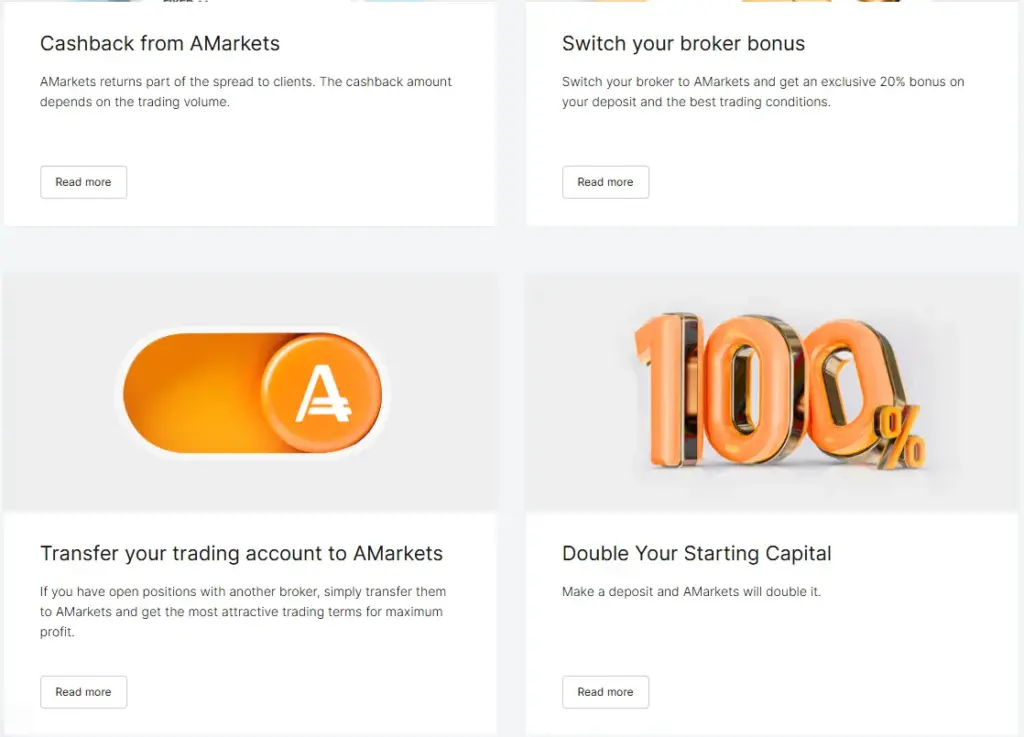
Bonuses are a classic marketing tool in the forex industry, and AMarkets uses them actively. However, most of the “pitfalls” are hidden within the bonus terms.
Types of Bonuses
AMarkets offers:
- Welcome Deposit Bonuses: e.g., a 100% bonus on the deposit amount or fixed amounts for verification/first deposit.
- Cashback: A rebate on part of the spread/commission, regardless of trading outcome.
- Partner Bonuses: Individual promo codes offering specific advantages.
GOLD Status Program
Special attention in this AMarkets review should be given to the GOLD Status. This is a loyalty program for active traders. The conditions for obtaining “Gold Status” typically involve either high trading volume or a large deposit. What does it offer?
- Cashback
- Priority withdrawals
- Access to premium analytics
The Downside: To receive these perks, you need to trade very actively, meaning you pay a lot in commissions/spreads. For many traders, the pursuit of GOLD Status leads to overtrading and, consequently, losses.
AMarkets review. Bonus Wagering Requirements: The Main Risk
This is the most crucial point for anyone considering taking bonuses from AMarkets or similar brokers. Bonuses are never given away for free. They are a marketing loan.
- How it works: You deposit $1000 and receive a $300 bonus (your account balance shows $1300, but $300 is the broker’s “virtual” money). To withdraw your $1000 plus any profit, you need to “wager” the bonus.
- Wagering Conditions: You are required to achieve a certain trading volume (e.g., 50 standard lots). Only after meeting this condition do the bonus funds become withdrawable (or are removed), and your own funds are unlocked.
- The Hidden Threat: If you generate profit but haven’t wagered the bonus, you cannot withdraw the money. If you incur losses and lose the deposit along with the bonus (e.g., lose that $1300), the broker hasn’t actually lost anything because the $300 was “virtual,” while you lost your real $1000. Bonuses at offshore companies often act as a “deposit magnet,” tying the client to the account and forcing them to take more risks to meet the conditions.
Conclusion: Bonuses are categorically contraindicated for traders who don’t understand the mechanics of “required turnover.” Professionals might potentially use a bonus as an extra cushion if the wagering conditions are reasonable and calculated, but in the offshore sector, they are almost always onerous.
AMarkets review. Client Reviews. Analyzing Online Feedback
For an objective AMarkets review, it’s necessary to analyze what real users are saying. The picture, as usual, is polarized.
AMarkets review. Negative Reviews and Critical Comments
Negative feedback about the broker can be found online. To find real problems, it’s worth looking at specialized forums or warning websites.
Main Complaints:
- Verification: Although ads mention “29-second verification,” users complain about delays or excessive demands when trying to withdraw larger sums. “Let’s ask for additional documents, proof of source of funds” – a classic stalling tactic.
- “Prohibited Strategies” Policy: Complaints that the broker (like many others) dislikes scalpers and those using high-frequency EAs if it leads to “suspicious activity.” In such cases, they may cancel profits or block the account, citing the rules.
- Spreads at Peak Times: Although advertised as “spreads from 0,” during major news events, they can blow out to dozens of pips, triggering stop-losses. This is a market feature, but beginners often see it as the broker “manipulating” prices.
- Bonus Traps: The main wave of negativity stems from a misunderstanding of bonus terms. People accept a bonus, then want to withdraw money, only to be told they need a turnover of 50 lots. Because the bonus is “virtual,” they lose their real money faster if the deposit is wiped out.
AMarkets review. Analysis on Independent Resources
Some expert reviews give a frankly harsh assessment. Some experts do not recommend AMarkets, as the company is not regulated by a top-tier body. They state directly that they “would not trust AMarkets with their own money” and advise looking for alternatives among brokers with FCA, ASIC, or CySEC regulation.
Verdict on Reviews
AMarkets is not a “scam” or a “bucket shop” in the classic sense, as they process small withdrawals for clients to avoid a completely tarnished reputation.
However, the nature of the negative feedback points to real issues: problems stemming from the jurisdiction, a rigid bonus policy, and the potential for account blocking on questionable grounds.
AMarkets review. Global Analysis of the Disadvantages of Trading with AMarkets
This is the key chapter of our AMarkets review. Here are all the drawbacks and risks gathered together, stripped of marketing gloss.
AMarkets review. Regulatory Vulnerability (The Main Disadvantage)
The absence of oversight from the FCA, CySEC, or ASIC means that, in essence, the client has no protection in case of bankruptcy or unfair practices by the company. The Financial Commission’s €20,000 compensation fund is not a reliable safeguard.
AMarkets review. Risk of Unilateral Changes to Terms
The offshore status allows the broker to change the rules of the game on the fly. In the histories of many forex brokers, there have been cases where during major news events (Brexit, US elections), companies “optimized” quotes, widened spreads astronomically, or introduced negative balance policies that were enforced as client debt. Although AMarkets claims negative balance protection, how strictly this is adhered to in an offshore jurisdiction is questionable.
AMarkets review. Regulator Warnings as an Indicator
As mentioned, the presence of warnings from CONSOB and other regulators is a marker that the company prefers to operate in a grey area, ignoring the legislation of developed countries. This speaks to a corporate ethic focused on profit maximization rather than legal compliance. For the client, this means that in a dispute with the company, they likely cannot turn to a reputable local arbitration body.
AMarkets review. The Bonus System as a Retention Mechanism
The bonuses described above are not gifts but tools to increase a client’s Lifetime Value (LTV). They force the trader to risk money that they cannot withdraw until they meet unrealistic trading volumes. This is a direct path to deposit loss for 90% of clients.
AMarkets review. High Leverage
Leverage of 1:3000 is a tool for rapid account depletion. Regulators in developed countries limit leverage to 1:30 (in Europe) precisely to protect retail clients. Enormous leverage attracts gamblers who don’t stay in the market long but manage to generate profit for the broker through spreads.
AMarkets review. Conflict of Interest in the “ECN” Model
Although AMarkets positions itself as an ECN/STP broker, the lack of strict regulation means the client cannot be 100% sure that their orders are actually being passed to the interbank market rather than being executed internally. The broker could selectively send losing trades to the market and keep winning trades for themselves.
AMarkets review: Should You Start Trading with AMarkets?
Drawing a conclusion to this AMarkets review, the following points can be made:
- Critically weak regulation. Registration in offshore zones (St. Vincent, Comoros) offers virtually no guarantee of fund safety at the legal level. This is the main drawback.
- Presence of official warnings from regulators in developed countries (Italy, Malaysia, etc.).
- Aggressive bonus policy that can be a trap for inexperienced users.
- High leverage that contributes to rapid ruin.
- A business model heavily reliant on affiliate programs, which potentially creates a conflict of interest between the trader’s and the partner’s interests.
AMarkets review. Conclusion
AMarkets is a typical representative of the “offshore broker” class.
By choosing AMarkets, you are betting that the company will conduct its business in good faith because, in the event of force majeure (sanctions, bankruptcy of a partner bank, change of ownership), the state mechanism for protecting your rights will not apply. You would have to rely solely on the company’s “goodwill.”
If you are an experienced trader fully aware of these risks and choosing them consciously for specific advantages (like high leverage), then this might be an option. For beginners or investors focused on long-term capital preservation, it is strongly recommended to avoid such brokers.
It is worth seeking an alternative among brokers licensed by the FCA or CySEC, even if their terms seem more modest. Reliability in the long term is more important than short-term gain.
Check the ratings and reviews of brokers on the page. Also read the articles in the News section.
More information about forex brokers’ affiliate programs is available on the website.
Please sign in to your account to leave a review