
Grand Capital
Legal Anomaly: Offshore Registration as a Mirror of Reliability
Any honest Grand Capital review must begin with the question: “Who actually stands behind the company, and who controls it?”. The answer to this question is the foundation of your safety. Let’s turn to the official data that the broker publishes on its regulation page.
Grand Capital review. The “License” from MISA: What Is It Really?
In 2024, Grand Capital announced it had obtained a license from the Mwali International Services Authority (MISA). Sounds impressive? Perhaps. But let’s figure out what’s hidden behind this facade.
MISA is the regulator for the autonomous region of the Comoros Islands. This is a small island nation in the Indian Ocean. To understand the level of regulation, just look at the facts:
Minimal Requirements
Obtaining such a license does not require a huge authorized capital (it often amounts to just a few thousand dollars).
Lack of Strict Oversight
Local authorities do not conduct thorough checks of the company owners’ business reputations, sources of funding, or the quality of services provided.
Zero Taxes
Offshore zones are created so that companies do not pay taxes, but at the same time, they bear practically no responsibility to their clients.
Grand Capital review. What does this mean for the client?
In essence, the MISA “license” is nothing more than a formality, a registration record. It provides no real protection for clients. If you have a dispute with the broker over a large sum, going to court in the Comoros Islands is pointless. The local jurisdiction simply has no mechanisms to force the broker to fulfill its obligations, especially if the company is physically located in another country (most often, such brokers operate from offices in CIS countries, Europe, or the Middle East, remaining “elusive” to local authorities).
Grand Capital positions this as a “commitment to global standards,” but in reality, choosing such a jurisdiction is a way to escape the oversight of truly serious regulators like the FCA (UK), CySEC (Cyprus), or BaFin (Germany). Obtaining a license in these countries costs millions of euros and requires absolute transparency.
Grand Capital review. Why Do Brokers Choose Offshore?
The answer is simple: minimal costs and lack of control. This allows the broker to do everything that is prohibited in regulated markets:
- Offer “leverage” with hyper-risks (1:1000 and above).
- Use questionable price quotes (chart manipulation).
- Delay fund withdrawals without explanation (formally, the broker sets the rules themselves, and they can change at any moment).
Thus, the phrase “MISA license” in any Grand Capital review should be perceived not as a mark of quality, but as a red flag, signaling maximum risks for your money.
Grand Capital review. Membership in FinaCom: Insurance Policy or a Pretty Badge?
On the regulation page, Grand Capital actively advertises its membership in The Financial Commission since 2016. It mentions a compensation fund of up to €20,000 and the “highest reliability category A.” This looks like strong backing, but let’s analyze this point in detail, as any honest Grand Capital review requires.
FinaCom is NOT a State Regulator
It’s important to understand: The Financial Commission is a non-governmental structure. It’s a so-called “external arbitration” or self-regulatory organization created by market participants for pre-trial dispute resolution.
How is FinaCom different from a real regulator (e.g., the Central Bank of Russia, FCA, or CySEC)?
Voluntary Participation
Companies pay for membership. If a broker violates the rules, FinaCom can at most expel them from the members, but it has no authority to freeze accounts or initiate criminal proceedings.
Compensation Fund
The fund’s assets are formed from contributions from the brokers themselves. This is not state insurance. The fund’s size is limited.
Jurisdiction
FinaCom’s decisions do not have the force of a court ruling. A broker can simply ignore them. Although, it’s worth noting that for brokers who value their reputation, expulsion from the commission is a negative signal.
Grand Capital review. Reliability Category A: Marketing or Fact?
Grand Capital claims that since 2018 it has been assigned reliability category A, and that this is the “highest category.” However, one needs to understand the criteria for assigning this rating. This assessment is also given by the Financial Commission itself, not an independent international agency (like Moody’s or S&P). In essence, it’s an internal rating for participants. It’s not too difficult to obtain if the company pays its fees and doesn’t have an avalanche of complaints.
Conclusion: Membership in FinaCom is an undoubted plus, as it gives the trader at least some tool of influence (the ability to file a complaint with a third-party organization). But it does not replace a license. In a dispute over $10,000, FinaCom might help, but if a broker decides not to pay $200,000, the commission’s capabilities would be extremely limited. It’s more of a “safety cushion” than “armor.”
Grand Capital review. Bonuses and Promotions: Analysis of “Hidden Pitfalls” and Wagering Requirements
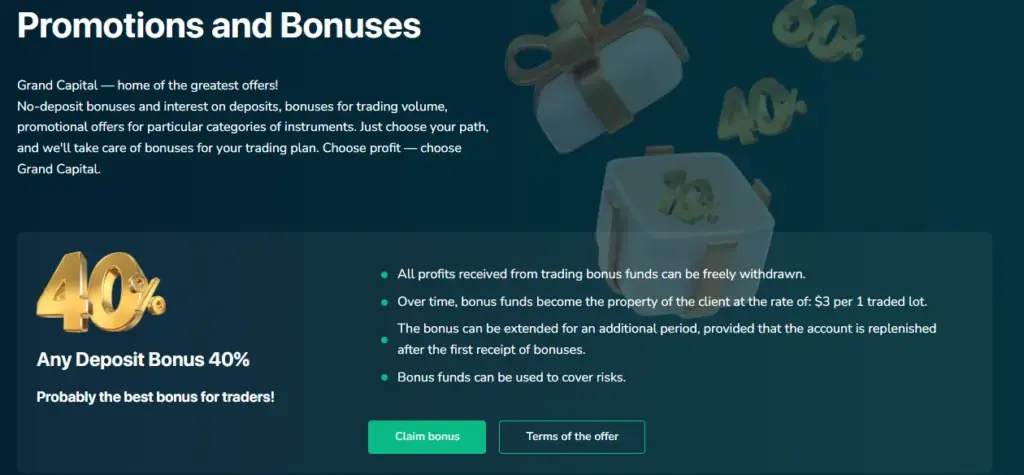
Grand Capital, like many offshore brokers, uses aggressive marketing to attract clients. The main tool is generous bonuses and promotions. At first glance, it looks like a gift: “Deposit $100 into your account, and we’ll give you another $50 for free!”. However, any experienced trader knows that there’s no such thing as a free lunch. In this section of the Grand Capital review, we will analyze the typical terms and conditions of bonuses.
Grand Capital review. Trading Conditions of Bonuses (Margin Requirements)
The main catch with bonuses is not that they need to be wagered (that’s standard), but how they need to be wagered.
Usually, bonus funds are credited to a separate account and cannot be withdrawn until the trader has traded a certain volume of lots. Problems begin when the trader loses their own funds.
Imagine this situation:
You deposit $1000, the broker gives you a $500 bonus (total balance $1500).
Terms: wager the bonus by trading a volume of 100 lots.
You start trading, but you have a series of losing trades. Your own deposit dwindles. Upon reaching a certain level of loss (for example, when only the bonus amount remains in the account), the broker may simply cancel the bonus, and your remaining money… often also “burns” or gets blocked, because according to the company’s rules, the bonus acts as “leverage” and its cancellation leads to a stop-out.
Hidden Fees and Restrictions
Often, the bonus terms include points that the client overlooks:
- Strategy Restrictions: You cannot use hedging (opposing positions) or scalping (ultra-short-term trading) during the wagering period. The broker’s robots track “prohibited” patterns, and the bonus may be voided retroactively.
- Expiration Date: The bonus must be wagered within a limited time frame (e.g., within 30 days). If you don’t make it, the bonus is forfeited.
- Profit Withdrawal: Often, profits generated using bonus funds cannot be withdrawn either until the full wagering volume is completed.
The Psychological Trap
Bonuses create the illusion of “easy money” and push the trader towards unjustified risk. Having virtual bonus funds in the account, the trader starts trading larger volumes (to wager faster), which leads to deposit loss. The statistics are relentless: the vast majority of accounts opened with bonuses lose money much faster than those trading only with their own funds.
In the context of a Grand Capital review, it’s important to note that the broker uses the classic “sticky bonus” model. They attract beginners, but experienced traders know that this is one of the most effective ways to force a client to trade non-analytically and lose money quickly.
Grand Capital review. Real Client Reviews: What to Expect When Working with the Broker?
When analyzing any Grand Capital review, one cannot ignore the “voice of the people.” Reviews on the internet are a litmus test, showing the real problems of interacting with the company. The picture is usually mixed: there are positive reviews (mostly from partners and those who managed to withdraw small amounts), but there is also a persistent layer of negative feedback that requires attention.
We have analyzed typical complaints on specialized forums (e.g., ForexPeaceArmy, RusForex) and review sites.
Grand Capital review. Main Categories of Negative Reviews
Problems With Fund Withdrawals (The Most Common Complaint)
This is a “classic” for offshore brokers. Typical stories:
- “I requested a withdrawal of $3000. Verification was completed, everything was fine. But the money never arrived. Support has been giving me the runaround for 3 weeks, demanding additional documents that weren’t on the list.”
- “I withdrew $500 without any issues. Decided to withdraw a larger amount — and the song and dance began. They ask for proof of income source, photos of cards from all sides, then they say the photo is blurry, and so on, round and round.”
- Reason: The broker is not a bank. Paying out large sums from their own pocket (especially if the client is in profit) is not profitable for them. The offshore status allows them not to pay with impunity, hiding behind “security rules” and “compliance checks.”
Trading Platform Manipulation (Requotes)
Complaints that at the moment of making a large profit, the terminal “freezes,” gets “kicked” from the server, or there is price slippage of tens of pips, turning a profitable trade into a losing one.
- *”I opened a trade on the news. There was a clear signal. The trade was opened at one price, but the stop-loss was triggered at a price 30 pips lower, even though the market didn’t go there.”*
- “I twice encountered a situation where the chart was flat, but my orders were executed at non-existent prices.”
Redirects (Asian Servers)
Some traders notice that their trades are not executed instantly, but with a delay, and the price moves against them. This resembles the operation of a so-called “dealing desk” (or “kitchen”), where the broker acts not as an intermediary to the real market, but as the client’s counterparty. If the client wins — the broker loses its own money, so it may slow down execution to “adjust” the situation.
Grand Capital review. Analysis of Positive Reviews
Positive reviews are also present. Most often, they fall into two types:
- Partner (IB) Reviews: People who attract clients (earning referral commissions) write glowing reviews to increase trust in the broker. Their income depends on how active the referred clients are, so it’s in their interest to advertise the company.
- “Micro-Earnings” Reviews: Clients who deposited $50, traded to $70, and successfully withdrew the $70. The problem is that such cases are bait. The system allows small fry to withdraw to create an appearance of honesty and lure in larger players.
Grand Capital review. Final Verdict: Is It Worth the Risk?
Summarizing this Grand Capital review, we can draw the following conclusions based on the analysis of the legal status, bonus policy, and client reviews.
Grand Capital is a typical representative of the offshore forex industry. The company has all the external attributes of legality (website, “island” regulator license, membership in a non-governmental commission), but behind this facade hides the highest risk for the client.
Main Disadvantages of Working with the Broker (Summary)
Lack of Real Regulation
The MISA license (Comoros Islands) is a formality, providing the client with no guarantees or protection mechanisms in case of legal disputes.
Conflict of Interest
The broker is a market maker (“dealing desk”). This means your profit is the company’s loss. This creates a temptation for the broker to manipulate quotes, delay order execution, or obstruct fund withdrawals.
Toxic Bonuses
Bonus programs are structured to “burn” the trader’s deposit as quickly as possible, forcing them to trade with inflated risks. The wagering requirements are often unattainable for normal trading without using scalping.
Risk of Non-Repayment of Large Sums
Numerous negative reviews point to a systemic problem with withdrawing large sums of profit. As long as the account is losing or the profit is small — there are no problems. As soon as the account becomes “fat,” bureaucratic delays begin.
Lack of Transparency
The real owners of the company are hidden. The head office is located in a jurisdiction where taxes don’t need to be paid, meaning the company is not interested in long-term cooperation with a client — it’s easier to find a new one.
Is It Worth the Risk?
If you are an experienced trader who wants to trade with their own funds, without bonuses, and are prepared for the broker to potentially block your account or delay payment indefinitely at any moment — you can try with small amounts, being fully aware of the risks. However, keeping significant capital with a broker registered offshore is, to put it mildly, shortsighted.
For long-term and safe trading, it is strongly recommended to choose brokers licensed by reputable regulators (FCA, CySEC, Central Bank of Russia, ASIC, etc.), where client funds are held in segregated accounts with top-tier banks and protected by compensation schemes at the state level. Grand Capital, unfortunately, does not fall under this definition.
We hope this Grand Capital review has helped you form an objective opinion about the company and make an informed decision.
Check the ratings and reviews of brokers on the page. Also read the articles in the News section.
More information about forex brokers’ affiliate programs is available on the website.
Please sign in to your account to leave a review